中国梦之声
China think tank releases report on Kunlun culture_我的网站

A |
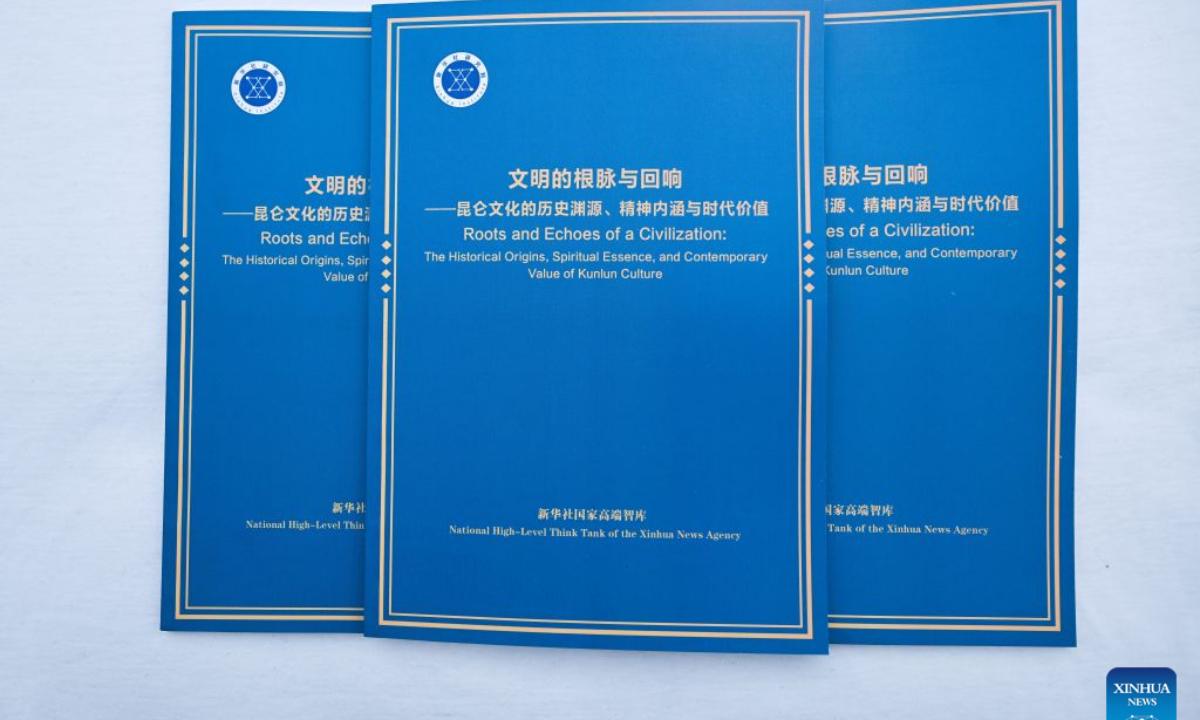
This photo shows copies of a think tank report examining the historical origins, spiritual essence, and contemporary value of Kunlun culture released during the Kunlun Culture Forum held in Xining, northwest China's Qinghai Province. A forum exploring the preservation and promotion of Kunlun culture, centering around a celestial peak in the shared mythology and collective memories of various Chinese ethnic groups, took place Wednesday in northwest China's Qinghai Province. The Kunlun Culture Forum, being hosted in Xining, capital of Qinghai, is dedicated to exploring the historical roots, spiritual connotations and contemporary relevance of Kunlun culture. (Xinhua/Zhang Long)A think tank affiliated with Xinhua News Agency released on Wednesday a report examining the historical origins, spiritual essence, and contemporary value of Kunlun culture.
The National High-Level Think Tank of the Xinhua News Agency unveiled the Chinese and English versions of the report at the Kunlun Culture Forum in Xining, capital of northwest China's Qinghai Province.
The report describes Kunlun culture as an important origin of Chinese civilization and a vital spiritual emblem of the Chinese nation. It said the culture offers both theoretical and practical guidance for carrying forward fine traditional Chinese culture, forging a strong sense of community for the Chinese nation, and advancing exchanges and mutual learning among civilizations.
Stretching over 2,500 km across western China with an average elevation surpassing 5,000 meters, the towering Kunlun Mountains have long been revered as "the ancestor of all mountains and the source of all waters."
Drawing on archaeological evidence and historical records, the report said Kunlun culture carries the historical memory of shared origins and symbiosis among ethnic groups in three dimensions: the cosmic cognition of early Chinese people, the spiritual homeland of the Chinese nation, and the territorial symbol of ancient China. It also confirmed the unity in diversity and inclusiveness of Chinese civilization.
The report summarizes five core values of Kunlun culture: harmony between man and nature, great unity, vigorous self-improvement, cherishing life and caring for the people, and all under heaven as one family.
Rooted in millennia of cultural inheritance and ethnic integration, these values have shaped the cosmological view, the state view, the ethos of great resolve and perseverance, the people-centered view, and the worldview of Chinese civilization.
In the new era, Kunlun culture has undergone creative transformation and innovative development.
Local regions have tapped into Kunlun cultural resources and made coordinated efforts to advance cultural inheritance, ethnic unity, ecological conservation and industrial development, said the report.
Through initiatives such as themed study tours, folk performances, and integrated cultural and tourism development, the regions are achieving cultural inheritance, the continuity of national ethos, and the improvement of people's incomes and well-being.
"Exploring the wisdom embedded in Kunlun culture can provide a temperate yet profound Chinese approach to dissolving antagonism among civilizations and resolving development dilemmas," the report noted.
It added that the concepts of "harmony between man and nature" and "all under heaven as one family" in Kunlun culture offer precious oriental wisdom for resolving ecological challenges, civilizational estrangement, and geopolitical antagonism, and for advancing the building of a community with a shared future for humanity.
In Chinese mythology, Kunlun is a sacred peak where the Queen Mother of the West resides and where the Yellow Emperor, the cultural progenitor of the Chinese nation, built palaces to inaugurate the civilization of ritual and music.
At least nearly 20 ethnic groups, including the Qiang, Yi, Jingpo and Pumi, trace their ancestry to the foot of the Kunlun Mountains. Since modern times, Kunlun has been a spiritual homeland for the Chinese, often eulogized to invigorate the national spirit in times of national peril.
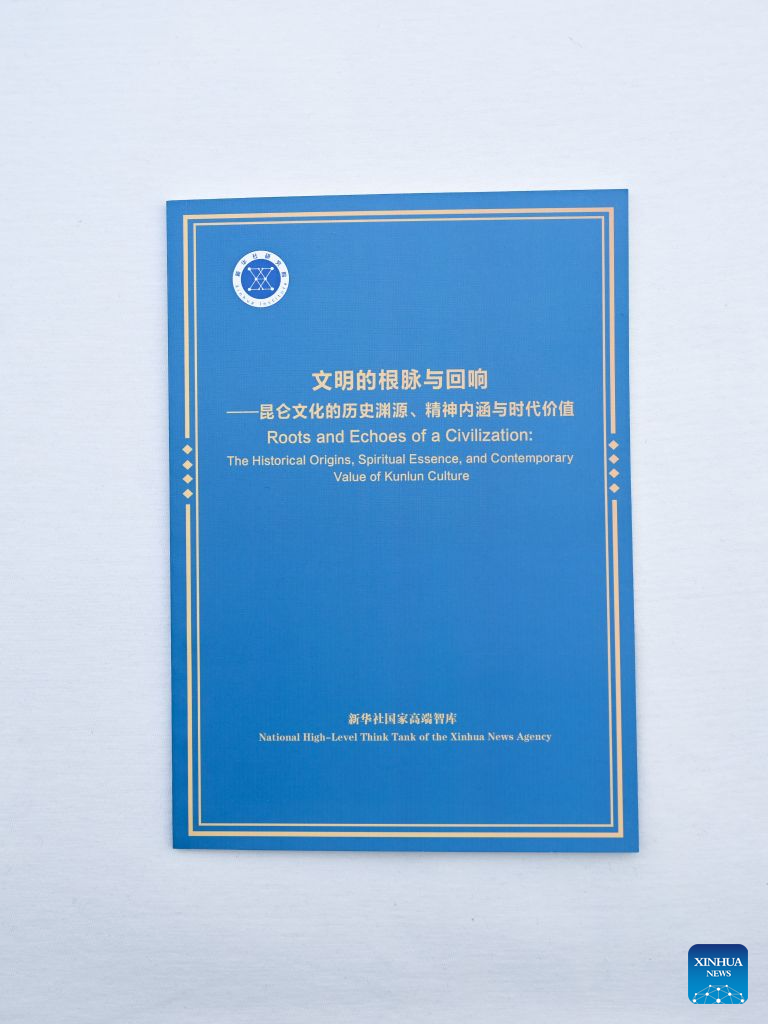
This photo shows a copy of a think tank report examining the historical origins, spiritual essence, and contemporary value of Kunlun culture released during the Kunlun Culture Forum held in Xining, northwest China's Qinghai Province. A forum exploring the preservation and promotion of Kunlun culture, centering around a celestial peak in the shared mythology and collective memories of various Chinese ethnic groups, took place Wednesday in northwest China's Qinghai Province. The Kunlun Culture Forum, being hosted in Xining, capital of Qinghai, is dedicated to exploring the historical roots, spiritual connotations and contemporary relevance of Kunlun culture. (Xinhua/Zhang Long)
。

B |

Illustration: Liu Rui/GTUS Pentagon official Elbridge Colby's latest Manila speech, in which he called on allies to "invest more" in their own defense and stressed that Washington wants "partners, not protectorates," has drawn attention from some Philippine media. Colby's claims also expose the fragility of the Manila-Washington alliance and Washington's push to enlist "Indo-Pacific" allies in serving its own strategic interests, a Chinese expert said, warning that the Philippines, by placing itself on the front line of provocations against China, risks being a geopolitical pawn left to bear the consequences on its own.
While delivering a speech at the Stratbase Institute in Manila, Philippines, on Monday, Colby, the Under Secretary of War for Policy, laid out the US' so-called "flexible realism" approach to the Indo-Pacific, stressing that the US is "definitely not disengaging from Asia" but strengthening its forward posture and seeking to build a "denial defense" along the First Island Chain, according to a transcript of the speech released on the US Department of War website.
At the same time, he called on US allies and partners to step up, invest more in their own defense, and take responsibility for their own sovereign security. "We are looking for partners, not protectorates," Colby claimed.
The claims have drawn attention from some Philippine media outlets, with some linking them to the South China Sea issue. However, the transcript of Colby's speech showed that he did not mention China, the Global Times found.
A Manila Bulletin report noted that after calling on allies to invest more in defense, Colby cited the Philippines as an example of the "kind of partner Washington wants to work with." He praised Manila for "strengthening its military and coast guard capabilities while deepening operational cooperation with the US" amid what the report described as China's "aggression" in the South China Sea.
Colby's visit to Manila marked his first official trip to Southeast Asia as an undersecretary under the Trump administration. He is scheduled to travel from Manila to Jakarta, Indonesia; Bangkok, Thailand; and Phnom Penh, Cambodia, said the report.
Meanwhile, a Manila Standard report interpreted Colby's remarks as showing that "the US is working closely with the Philippines" to strengthen Manila's military capabilities and protect its sovereign rights in the South China Sea, despite the fact that Colby did not mention China in his speech.
The US appears to be adopting a more retrenchment-style approach, shifting from leading directly to relying on regional allies to take the frontline role while providing support. This approach allows Washington to advance its interests while lowering its own costs, Song Zhongping, a Chinese military affairs expert, told the Global Times.
Song noted that Washington seeks to use repeated maritime frictions to tie down Chinese resources, which helps explain Colby's praise for Manila: the Philippines bears part of Washington's strategic burden while receiving largely rhetorical US support.
A South China Morning Post report on Tuesday noted that Colby avoided mentioning the recent disputes over Huangyan Dao, despite Washington having criticized China's establishment of a nature reserve there just two days earlier. The report described the omission as a "measured tone" ahead of a potential meeting between the Chinese and US leaders.
Washington's primary concern is its own interests. At the core of its "Indo-Pacific strategy" is strengthening its alliance network by pushing partners such as the Philippines to shoulder greater security burdens in pursuit of US strategic goals. As US-China diplomatic dynamics evolve, countries serving as Washington's geopolitical spearheads in confrontations with China risk being left behind, said some observers.
Song noted that this also reveals the fragility of the US-Philippine relationship.
The US has encouraged the Philippines to take the front line in confrontations with China while offering mostly rhetorical support. Should tensions escalate, Manila would bear much of the cost on its own, said the expert.
。

C |
Current article:http://bi6y.zhanggengsenchaiweikeng.cfd/84w/9zxq.html
Published on:02:08:40
